
Project visuals
Interface screenshots, reconstructed deliverable extracts and workflow illustrations are labelled. All visuals use fictional content and metadata, with client branding removed. Select an image to view it full size.
The engagement
A luxury house was replacing its PIM with Akeneo and migrating its DAM to Bynder. The DAM taxonomy had been designed around a new product segmentation, yet no project document specified the flow meant to feed those metadata. The question was easy to state and expensive to settle: can every DAM file be automatically tied to its product segmentation, and through which data path?
Rather than reasoning on paper, we worked on real data from both platforms. We measured overlap rates for the candidate identifiers, tested a cascade of matching keys, recorded the actual cardinalities of the product metaproperties, and probed the DAM API's real constraints: pagination, rate limits, bulk update behaviour.
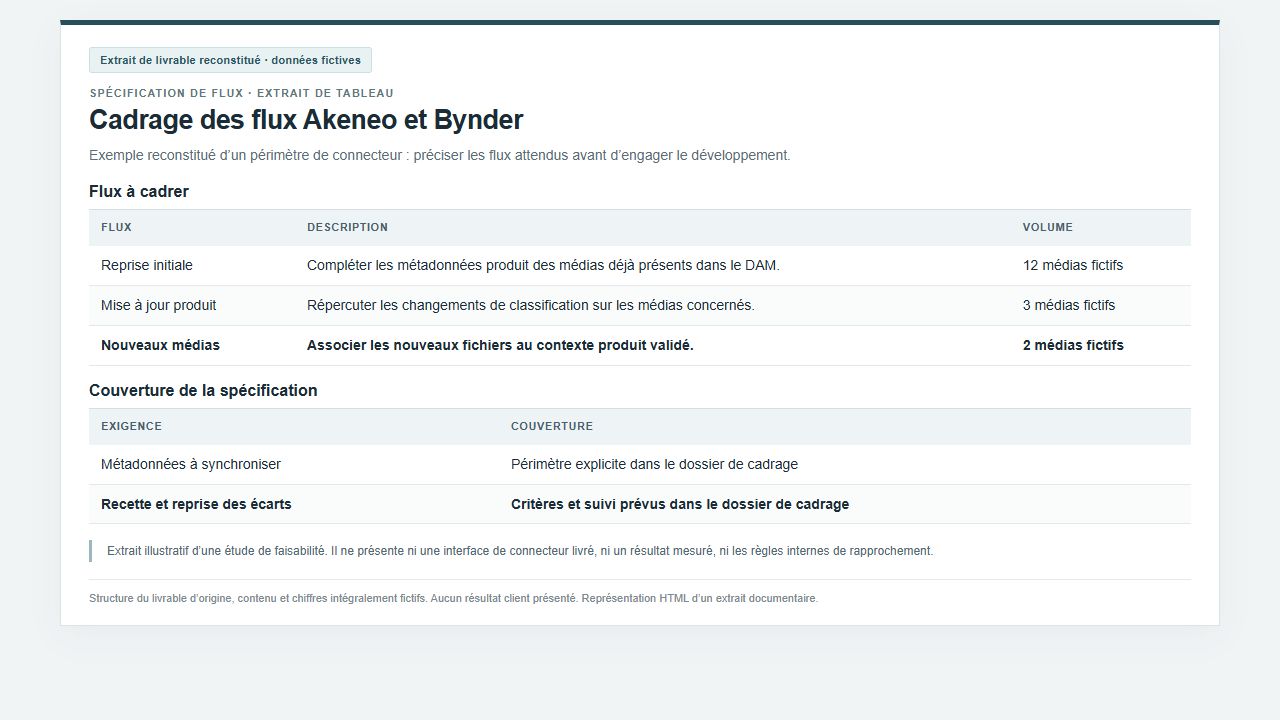
We delivered a feasibility report broken down by area and an interface specification: documented key cascade, product metaproperty mapping with cardinalities, flows selected for a first version, measured API constraints, a staged rollout sequence with a rollback snapshot, and acceptance criteria. The client got an informed, effort-costed decision rather than an intuition.
Takeaway
A takeaway for your project
We gave the client the evidence needed to decide which connector to build, using measured data matches and verified API constraints.
Technologies
- Akeneo
- Bynder
- API REST
This engagement is one of the integrations documented on our dedicated page. We present delivered work, feasibility studies and scoping engagements, with the checks to make before development.
What to settle before committing to an integrationYour next step
Can your assets be linked to your products?
Describe your Akeneo and Bynder use cases and available identifiers. We can assess matching options and scope the interface before development.
Discuss your project