Bynder · PIM · CMS · Automation
Custom Bynderintegrations.
Bynder · inRiver · Akeneo · WordPress · Drupal
Selected engagements
From feasibility to a delivered connector.
Each engagement serves a different stage. We clarify what needs validating, building or improving so the work can move forward with a defined scope.
Your workflows, our starting point
The right asset, in the right place.
We start with your teams’ work: matching products with assets, simplifying publishing and understanding synchronization discrepancies.
Connect DAM and PIM
Assets and product information need to meet without re-entry. Scoping establishes identifiers, variants, field ownership and withdrawal rules.
inRiver: middleware delivered. Akeneo: feasibility study and specification.
Publish from DAM to CMS
A selected asset needs its context: alternative text, derivatives, rights and publication status. Editorial requirements determine connector behavior.
Elementor: dedicated plugin. Drupal: connector scoping.
Make an existing synchronization reliable
A successful run is not enough when some assets are skipped. We plan readable discrepancies, actionable rejections and controlled recovery instead of restarting everything.
Maintenance scope and arrangements are agreed during scoping.
Standard or custom
Build what makes the difference.
The Bynder marketplace already offers integrations. We check their fit with your data and workflows, then identify the adaptations you need.
Evaluate existing options
Functional coverage, compatibility, rights management, maintenance and extension options.
Isolate custom requirements
Complex matching, multiple instances, specific business rules or centralized monitoring needs.
Isolated Tools
Your systems don't communicate with each other
Centralized Integration
Before
After
Unified Ecosystem
All your tools connected, synchronized, and working in harmony
Illustrative flow
4
Systems
1
Single Source
0
Conflicts
Our approach
From scoping to an operable integration.
A concrete deliverable at each stage helps you decide what comes next. We validate the rules against a representative sample before scaling up.
Scope against your data
Platforms, flow direction, volumes, available identifiers and business rules. Deliverable: scope, risks and acceptance criteria.
Specify the behavior
Mapping, source of truth, creation, updates, withdrawals and rejected cases. Deliverable: interface specification and development estimate.
Build and validate
A representative pilot, simulation before writes and business validation. Deliverable: a connector tested against the agreed scope.
Prepare operations
Execution logs, error handling and responsibilities. Deliverable: operating documentation and a recovery procedure to check the flow and escalate an incident.
WordPress · Elementor
Your assets, inside your editor.
A concrete CMS need: select a Bynder asset inside WordPress and retain its reference for image rendering. We scope this workflow and widget compatibility on your Elementor installation.
Explore the integration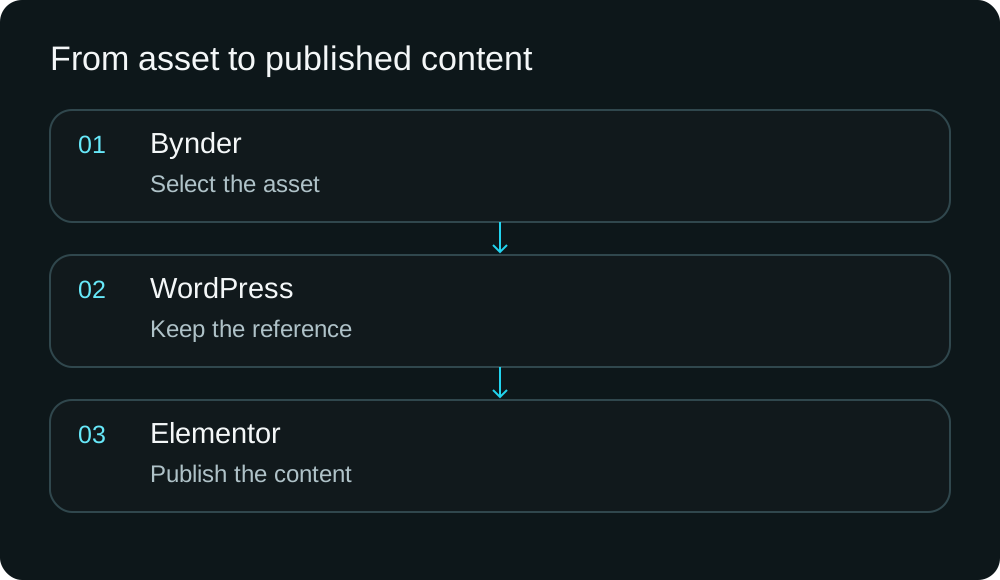
Prepare your project
The right questions, before connecting.
Our guides help you choose an approach, prepare your data and frame discussions with your teams.
Frequently asked questions
Before getting started.
Is a custom connector always needed?
No. If an existing integration covers your matching rules, formats and publishing needs, evaluate it first. Custom development is justified by identified gaps, not platform names.
Can you take over an existing connector?
Yes, after reviewing the available code, access, documentation and incidents. The diagnosis identifies what can be retained and what needs changing before estimating the takeover.
What do you need for an estimate?
Platforms and versions, expected flows, volumes, anonymized examples and the deadline. If identifiers or business rules are uncertain, a feasibility phase precedes development.
Let’s discuss your workflow
Your next integration starts here.
Share your platforms, flow direction and deadline. We help you clarify the need, the checks required and the next step.
Scope your integration