
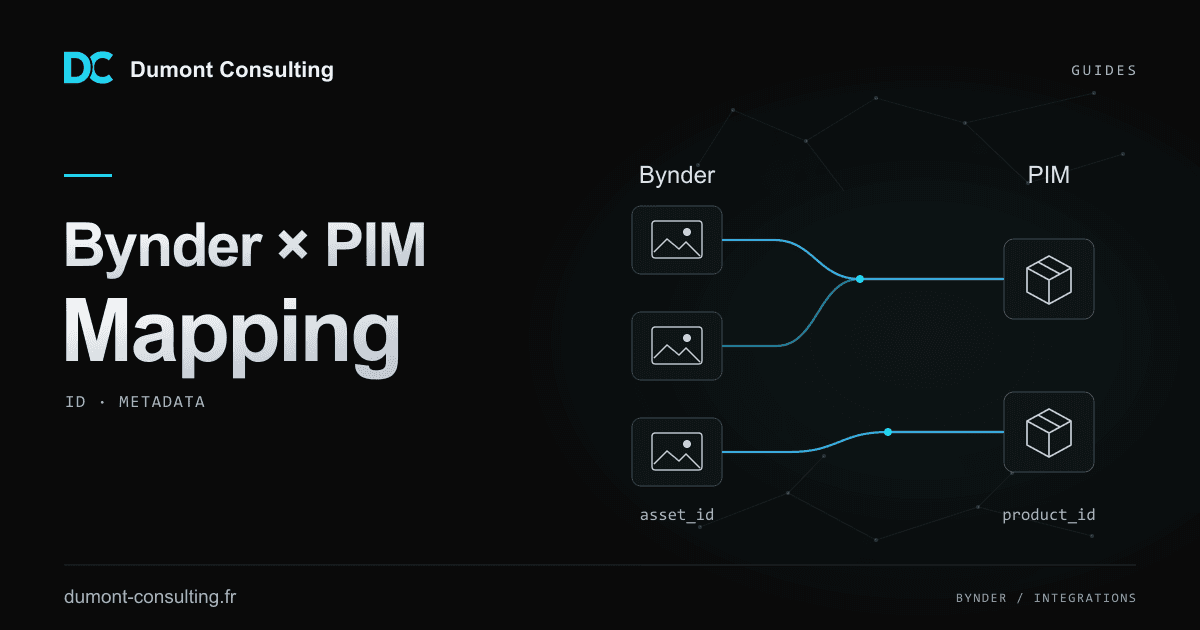
Consider an image that relates to several product references, while one variant has its own media. Connecting the platforms does not determine the correct association. Before estimating a Bynder and PIM integration, we check which data supports that decision and which rules need to govern it.
Assign ownership of each piece of information
Start with the information that publishing depends on: product reference, variant, language, media type, status and usage rights. For every exchanged field, identify an authoritative system and someone who can resolve exceptions.
If both platforms can change the same field, specify which value takes precedence and under what circumstances. Bidirectional synchronization needs explicit rules to keep a business correction from being undone on the next pass. We record those decisions in the scope before choosing the exchange mechanism. Ownership should remain clear when an employee changes roles or a new channel is added.
Check matching against a real sample
Prepare an authorized sample covering useful families and situations: a simple product, variants, a shared document, older media, a missing reference and a duplicate. The expected result is a readable breakdown of reliable matches, ambiguous cases and files with no matching record.
Identically named fields in two tools do not prove that their values are populated or unique. We examine what the data actually supports. Our Akeneo and Bynder feasibility case study describes that approach and the specification delivered to the client. The documented deliverable is a study; it does not claim deployment of the connector.
Check the metadata model
A valid association also needs to be represented in the DAM. Bynder describes single-select, multi-select, text and date metaproperties in its metaproperty creation documentation. Check that the expected values fit the selected type.
We request a mapping that business teams can read: source information, destination, transformation rule and behavior when a value is missing. It should also say who approves new values. This review helps surface cases where a field designed for one reference actually needs to represent several, before acceptance testing begins.
Decide what happens when something changes
Describe file replacement, metadata changes, expiry and product withdrawal separately. Each event may need a different response: update a reference, stop its distribution or flag an intervention. Assign that response explicitly rather than assuming that every removed value should trigger deletion elsewhere.
The Bynder API documentation describes permissions by operation and request limits. We therefore verify available access and the ability to process your scope. An API being available does not establish the time needed to complete a production run.
Define the evidence needed for acceptance
A successful job count alone cannot establish the quality of the associations. Acceptance should find the correct media on the correct products, explain rejected items and verify the agreed withdrawals. We recommend a representative pilot with business validation and an explicit decision before broadening the scope.
Also identify who reviews discrepancies, what support is available and what should happen after an interruption. Our DAM and inRiver middleware case study describes a delivered solution with a control point between the platforms.
Our DAM, PIM and CMS integration engagements provide further examples of scopes and deliverables. They distinguish delivered implementations from studies and scoping work.
Prepare the information needed for an estimate
- Platforms, versions, instances and responsible people.
- Expected workflows, direction of exchange and business deadline.
- An authorized sample and its expected associations.
- Known volumes, change frequency and acceptable delay.
- Rules for rights, replacement and withdrawal.
- Acceptance criteria and ownership of day-to-day monitoring.
The expected scoping deliverable brings together a mapping reviewed with business teams, exceptions to handle, a test set with acceptance criteria and the pilot scope. Rules that remain unresolved should appear as decisions to make before development starts.
Frequently asked questions
Do we need the entire media library to start?
A representative sample and volume information can support initial scoping. Broader access is then defined according to the checks that are needed.
Do these checks also apply to an existing connector?
Yes. They establish its coverage and whether configuration is sufficient. The Bynder marketplace lists an Akeneo integration developed by Dataggo, for example; its fit needs to be checked against the actual requirement.
To compare that coverage with the documented requirement, see our guide to standard Bynder connectors and custom development. It provides a common brief and checks to make before choosing configuration, an extension or a dedicated build.
Prepare the pilot with us
You can start with the platforms, main matching scenarios and rules already defined. Our Bynder integration approach explains how we work. Describe your PIM and DAM workflow and we will identify the checks needed to scope and estimate the pilot.